The new valyu Whitepaper
on the topic “Successful Ownbrands”
on the topic “Successful Ownbrands”
Content
Success factor: Ownbrand
Offering more value
Sharpening the profile
Controlling the supply chain
Modern private label management
Let’s design valyu
Situation
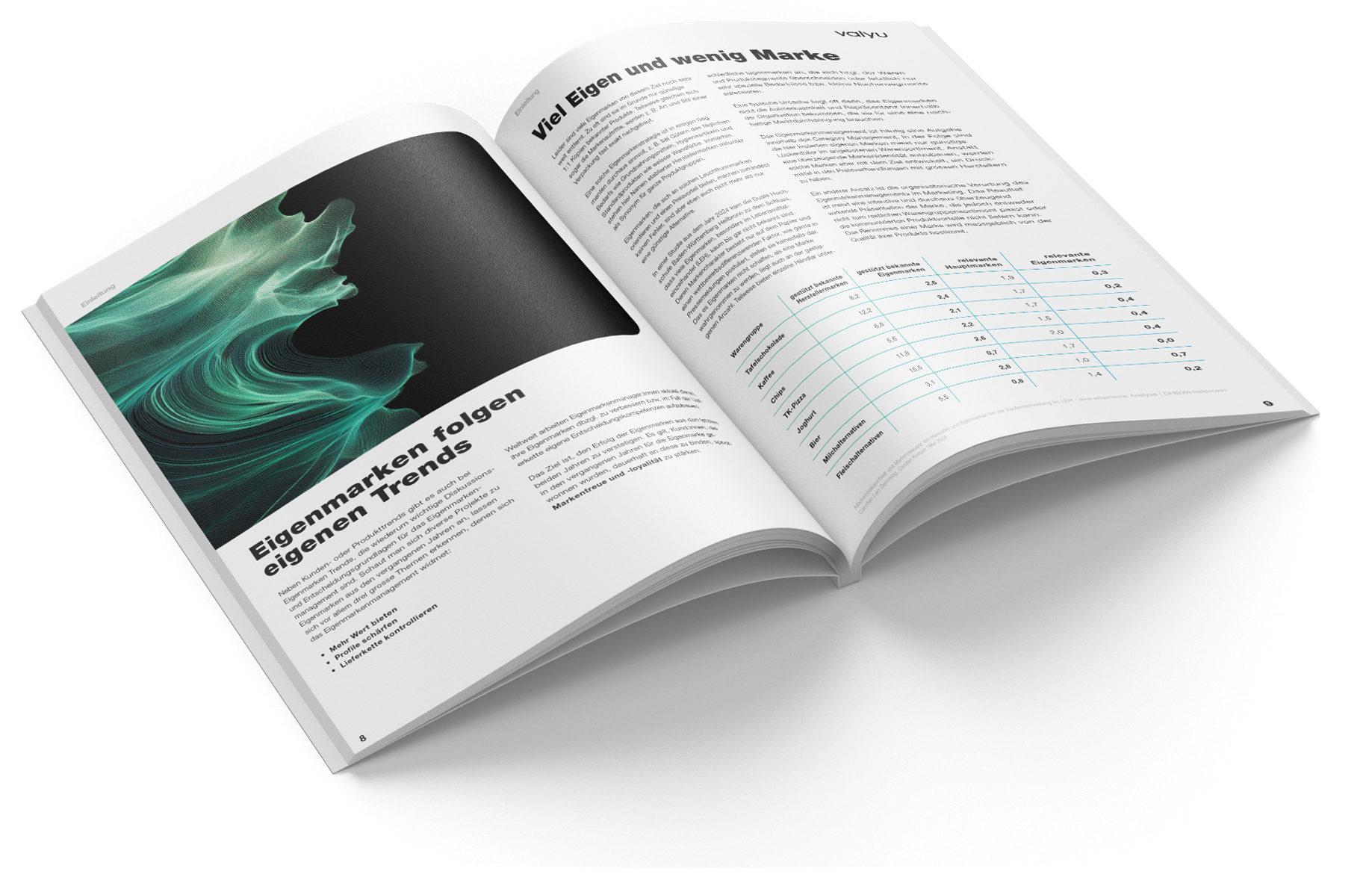
In recent years, many retailers have been very successful in attracting customers to their private label assortments. Now, the next step is to permanently bind them to the brand. The task is to take further steps to offer customers more value, sharpen the profile of ownbrands, and minimize risks in the supply chain. Offering customers a price advantage alone is no longer sufficient. They must be provided with the added value that major brand manufacturers have so far overlooked or been unable to deliver. In order not to get lost in the continuous growth of new (private) labels, simply being a good copy of well-known brands is no longer enough. Ownbrands today require a clear profile and the courage to be proactive. Political and social changes, as well as climate change, are putting increasing pressure on established supply chains. For the success of ownbrands, therefore, an attractive brand presence must go hand in hand with questions of product and production design, which are becoming ever more important.
Problem
However, all these aspects require specific skills and structures in private label management, which are still too rarely encountered today. Private label departments are still too often co-managed by other divisions within the corporate organization instead of being granted the entrepreneurial freedom with which product manufacturers have successfully built their brands for decades. Strong ownbrands cannot be developed on the side, nor within the scope of a one-off project.
Solution
Private label management should be understood as an independent, permanent, and strategic discipline. It must be able to develop a long-term vision for the brands while also responding to short-term market impulses. For this, organizational independence within the company is required in order to effectively manage the specific opportunities and challenges of a private label. Increasingly, private label managers need a strong sense for strategic issues as well as the ability to formulate hypotheses, validate them, and derive measures from them. Our specially developed SDCM method helps in this regard. It provides a holistic approach to developing innovative private label concepts with the potential to deliver what a modern private label should be: a factor of competitive differentiation.
Want to read more?
Simply fill in the required details below and download the Whitepaper as a PDF!